
Share this on:
What You'll Learn
Organizations today rely on data to understand customers across sales, marketing, service, and digital channels. However, customer data often lives in multiple systems, CRM platforms, marketing tools, e-commerce systems, and data warehouses. The result is fragmented information and delayed insights.
Building Customer 360 strategy aims to bring these scattered datasets together into a unified customer view. But one major challenge stands in the way: latency between systems. When data moves too slowly, customer interactions happen based on outdated information.
The solution is a modern integration approach that blends batch processing with real-time data pipelines, enabling organizations to deliver accurate and timely customer insights.
The Latency Problem in Traditional Integration
Traditional data integration methods often rely heavily on batch processing, moving data in scheduled intervals such as hourly or nightly jobs. While batch pipelines work well for high-volume processing and historical analytics, they can create delays between systems.
For example:
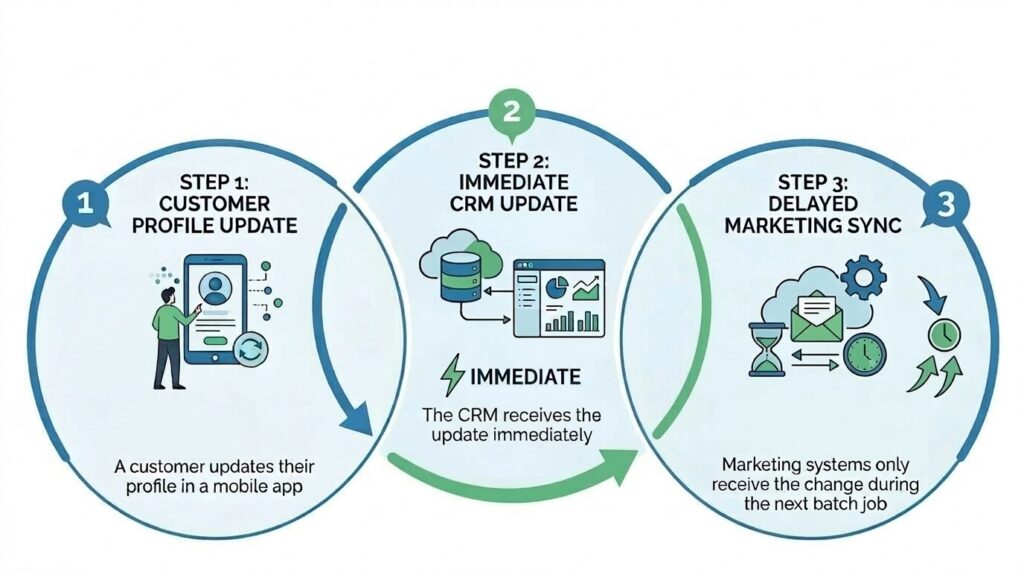
The above image leads to a situation where, by the time the data synchronizes, the organization may already have sent irrelevant messages or missed opportunities for engagement.
Modern businesses require near real-time data movement so that every system operates with the latest customer context.
Why Hybrid Pipelines Matter
Rather than replacing batch processing entirely, leading organizations use hybrid pipelines that combine batch and real-time integration.
Real-time integration captures and delivers data the moment it changes, enabling immediate insights and actions. This approach allows enterprises to process events and synchronize systems with minimal latency.
In a hybrid model:
Batch pipelines handle:
- Large historical datasets
- Data warehouse updates
- Periodic reconciliation processes
Real-time pipelines handle:
- Customer interactions
- Transaction updates
- Event-driven triggers across systems
This balanced architecture ensures both efficiency at scale and instant responsiveness.
Event-Driven and API-Based Data Ingestion
To power real-time integration, organizations increasingly adopt event-driven architectures and API-based ingestion patterns.
In an event-driven model:
- Systems publish events whenever data changes
- Integration pipelines capture those events
- Downstream applications react immediately
For example:
- A customer places an order online
- An event is generated instantly
- The order status, customer profile, and marketing system are updated in real time
APIs also play a critical role by enabling systems to exchange data dynamically rather than waiting for scheduled transfers.
These approaches ensure that data flows continuously between operational systems, analytics platforms, and customer engagement tools.
Enabling Real-Time Customer Activation
The goal of integrating customer data is activation, using insights to drive better experiences and decisions.
While building customer 360 when integration pipelines support real-time data movement, organizations can:
- Trigger personalized marketing campaigns instantly
- Provide support agents with up-to-date customer context
- Detect fraud or anomalies during transactions
- Deliver dynamic product recommendations
Real-time downstream activation transforms building Customer 360 from a reporting concept into an operational capability.
Where LumenData Fits In
Implementing hybrid integration architectures can be complex. Enterprises must connect multiple systems, maintain data quality, and ensure pipelines scale as data volumes grow.
This is where LumenData plays a critical role.
With deep expertise in customer data platforms and integration frameworks, LumenData helps organizations design and implement scalable data integration architectures that support both batch and real-time processing.
Key capabilities include:
- Designing hybrid pipelines using Informatica Cloud Data Integration
- Implementing event-driven and API-based ingestion frameworks
- Reducing latency between enterprise systems
- Enabling real-time activation of building Customer 360 insights
By combining modern integration patterns with proven enterprise platforms, LumenData helps organizations build data ecosystems that support both speed and scale.
The Future of Building Customer 360 Integration
Customer expectations continue to rise, and organizations can no longer rely solely on overnight data processing. Real-time intelligence is becoming the foundation of digital customer engagement.
A hybrid batch + real-time integration strategy allows enterprises to:
- Maintain reliable large-scale data processing
- Eliminate latency across operational systems
- Deliver personalized, real-time experiences
About LumenData
LumenData is a leading provider of Enterprise Data Management, Cloud and Analytics solutions and helps businesses handle data silos, discover their potential, and prepare for end-to-end digital transformation. Founded in 2008, the company is headquartered in Santa Clara, California, with locations in India.
With 150+ Technical and Functional Consultants, LumenData forms strong client partnerships to drive high-quality outcomes. Their work across multiple industries and with prestigious clients like Versant Health, Boston Consulting Group, FDA, Department of Labor, Kroger, Nissan, Autodesk, Bayer, Bausch & Lomb, Citibank, Credit Suisse, Cummins, Gilead, HP, Nintendo, PC Connection, Starbucks, University of Colorado, Weight Watchers, KAO, HealthEdge, Amylyx, Brinks, Clara Analytics, and Royal Caribbean Group, speaks to their capabilities.
For media inquiries, please contact: marketing@lumendata.com.
Authors

Content Writer

Technical Manager